Vietnamese Drip Coffee: Pro Brewing Tips
Among the many modern brewing methods available today, Vietnamese phin drip coffee still holds a special place in daily life...
read more

FREE Express Shipping On Orders $99+


When analyzing the sensory characteristics of Phin coffee, many people often wonder why this beverage delivers such a bold and intense sensation. The secret does not lie in complex machines, but rather stems from the quiet interaction between water, temperature, and organic compounds within the ground coffee. By analyzing this from a physical and chemical perspective, we can better understand the actual mechanisms occurring inside this familiar brewing tool.
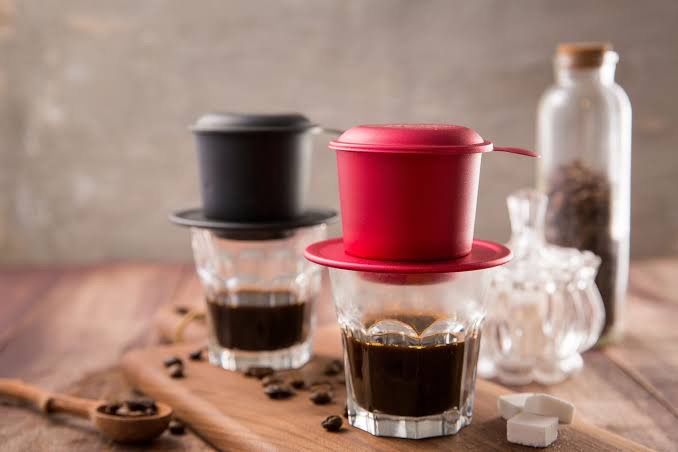
The extraction process of Vietnamese Phin coffee relies entirely on natural gravity (Image source: Internet)
Essentially, coffee extraction is a process where a solvent (hot water) interacts with solids (coffee grounds) to dissolve flavor compounds. In machine-brewed methods like Espresso, hot water is pumped through the coffee bed with massive mechanical force, typically at 9 bar. Under high pressure, the dissolving process occurs incredibly efficiently and rapidly, taking only about 25 to 30 seconds to produce an extract with a very high total dissolved solids (TDS) concentration, usually falling between 8–12%.
Conversely, the Phin coffee method relies entirely on natural gravity to create flow. There is no pumping system, nor any mechanical pressing force other than the weight of the water and the light compression from the gravity insert. The poured hot water permeates the coffee bed through capillary action, diffusion, and percolation. This slow flow rate extends the contact time up to 3 to 5 minutes, allowing water molecules to move along the concentration gradient to dissolve internal compounds.
This difference in physical mechanisms leads to a change in the final flavor structure. Although the long contact time allows the extraction process to occur slowly, the total dissolved solids (TDS) concentration of this manual method is actually often significantly lower than that of Espresso, depending on the brewing ratio and technique. However, the combination of other foundational factors such as bean type, roast level, and natural oil content compensates for this difference, creating the characteristic “bold” sensation on the palate.
This metal drip tool is a prime example of applying natural flow to alter the dissolution rate of various compound groups. In brewing science, compounds in the coffee grounds do not dissolve simultaneously at the same rate. Contrary to popular belief, caffeine is a polar substance and dissolves very quickly in hot water; therefore, it is extracted quite early and continues to dissolve throughout the brewing process. Along with caffeine, hot water rapidly sweeps away volatile organic acids and fruity flavor compounds, followed by the release of natural sugars.
Towards the end of the extraction process, when the water has been in contact with the coffee bed long enough, more complex and less soluble compounds begin to appear more abundantly in the solution. Typical among these are high-molecular-weight phenolic compounds and several other astringent and bitter-tasting substances. With a 3 to 5-minute drip, the slow flow creates favorable conditions for water to dissolve more of these heavier compound groups.
This does not mean that fast brewing methods like Espresso do not extract bitterness. Under 9 bar of pressure and a low water ratio, the espresso machine still extracts a large amount of caffeine, melanoidins, and bitter compounds, but the proportion of these substances is balanced out by a high concentration of other dissolved solids. Meanwhile, the prolonged steeping time of Phin coffee alters the specific gravity of the extracted compounds introduced into the cup, creating a particularly profound impression of bitterness and a lingering intensity in the aftertaste.

Dark-roasted Robusta beans create a bold, full-bodied cup of coffee that is hard to resist (Image source: Internet)
Besides the physical aspect of the flow, the biological properties of the raw material serve as a foundational variable that cannot be ignored. The boldness comes not only from the brewing method but also depends largely on the type of bean. Typically, dark-roasted coffee beans are the unspoken standard for this traditional method. The high-temperature roasting process makes the cellular structure of the beans more porous, brittle, and cracked, creating favorable conditions for water to easily penetrate, permeate, and dissolve the compounds within.
More notably, the Robusta beans predominantly used in Vietnam carry highly distinct biochemical traits. According to in-depth analyses, Robusta contains a caffeine content (about 2.0% to 2.7%) that is 1.5 to 2 times higher than that of Arabica beans. Robusta beans also possess a very abundant amount of chlorogenic acid. During the dark roasting process, a portion of the chlorogenic acid thermally decomposes into quinic acid—a compound that contributes to a sharp sourness and a feeling of astringency. Meanwhile, the intense bitterness of dark-roasted beans stems from large amounts of caffeine, chlorogenic acid lactones, and phenylindanes.
When combining dark-roasted Robusta beans with a long steeping time, we achieve ideal conditions in terms of extraction. The continuously slow-flowing water drags an abundant amount of caffeine and bitter compounds from the grounds into the final cup. Conversely, if the same beans were put into an Espresso machine, the high pressure would create a layer of crema—a complex mixture of CO₂ gas, oils, water, melanoidins, and proteins—along with a high dissolved solids concentration, delivering an entirely different flavor experience and visual structure.
A scientific aspect rarely discussed but directly affecting extraction dynamics is the thermodynamics of the brewing tool. The phin is usually made from metals such as aluminum or stainless steel. These metallic materials have their own heat absorption and conduction properties, directly impacting the temperature environment of the steeping water inside.
When boiling water (around 90-95 degrees Celsius) is poured in, the metal surface absorbs a portion of the thermal energy, contributing to a natural temperature decline curve throughout the 5 minutes of dripping. The water in the initial stage is hot enough to quickly activate and dissolve the highly soluble essential compound groups. However, moving into the final minutes of the cycle, the temperature of the water mass has dropped significantly.
This gradual decrease in temperature may help limit the continued extraction of too many astringent-tasting compounds in the final stage, alongside other crucial factors such as grind size, water ratio, steeping time, and agitation. In contrast to modern espresso machines that use a proportional-integral-derivative (PID) controller to maintain a much more stable temperature throughout the 25–30 second cycle, the temperature fluctuation over time in Phin coffee can affect the dissolution rate of flavor compounds and help shape its distinct sensory profile.
The final factor explaining the full-bodied sensation of the beverage lies in fluid dynamics as it passes through the filter. In the world of manual brewing, paper filters act as a superior barrier, retaining all micro-fines and absorbing most of the natural oils and fats present in the beans (such as cafestol and kahweol). As a result, coffee brewed through a paper filter is usually very clear, delivering a light and clean mouthfeel.
However, the Vietnamese coffee filter, with its mechanically perforated metal filter design, allows a different physical process to take place. These perforated holes are large enough to let a certain amount of insoluble micro-fines and oil emulsions pass through, falling directly into the cup. Metal filters retain far less oil than paper filters. The presence of these invisible suspended particles and lipid content creates a colloidal suspension that increases the mechanical viscosity of the liquid.
When tasted, these micro-fines and natural oil films coat the surface of the tongue, enhancing the perception of viscosity and the body of the beverage. This is the core reason why this beverage provides a heavy and thick sensation on the tongue, completely independent of the TDS dissolved solids measurement. Machine brewing methods also use metal filters, but the short duration and strong pressing force cause the oil emulsion to combine with air bubbles to form crema, rather than blending evenly into the liquid like the slow-drip method.
Read more:
In conclusion, the distinctiveness of Phin coffee is not merely a subjective perception but the result of clear chemical and physical processes. This method utilizes capillary action, natural temperature variation, and the mechanical properties of the metal filter to extract flavor. By letting the water interact slowly with dark-roasted Robusta beans, the resulting beverage retains a large amount of natural oil, an abundance of bitter-tasting compounds, and delivers a full-bodied viscous mouthfeel. These foundational scientific elements help explain why this traditional beverage has always maintained its original appeal and holds a firm position in drinking culture.