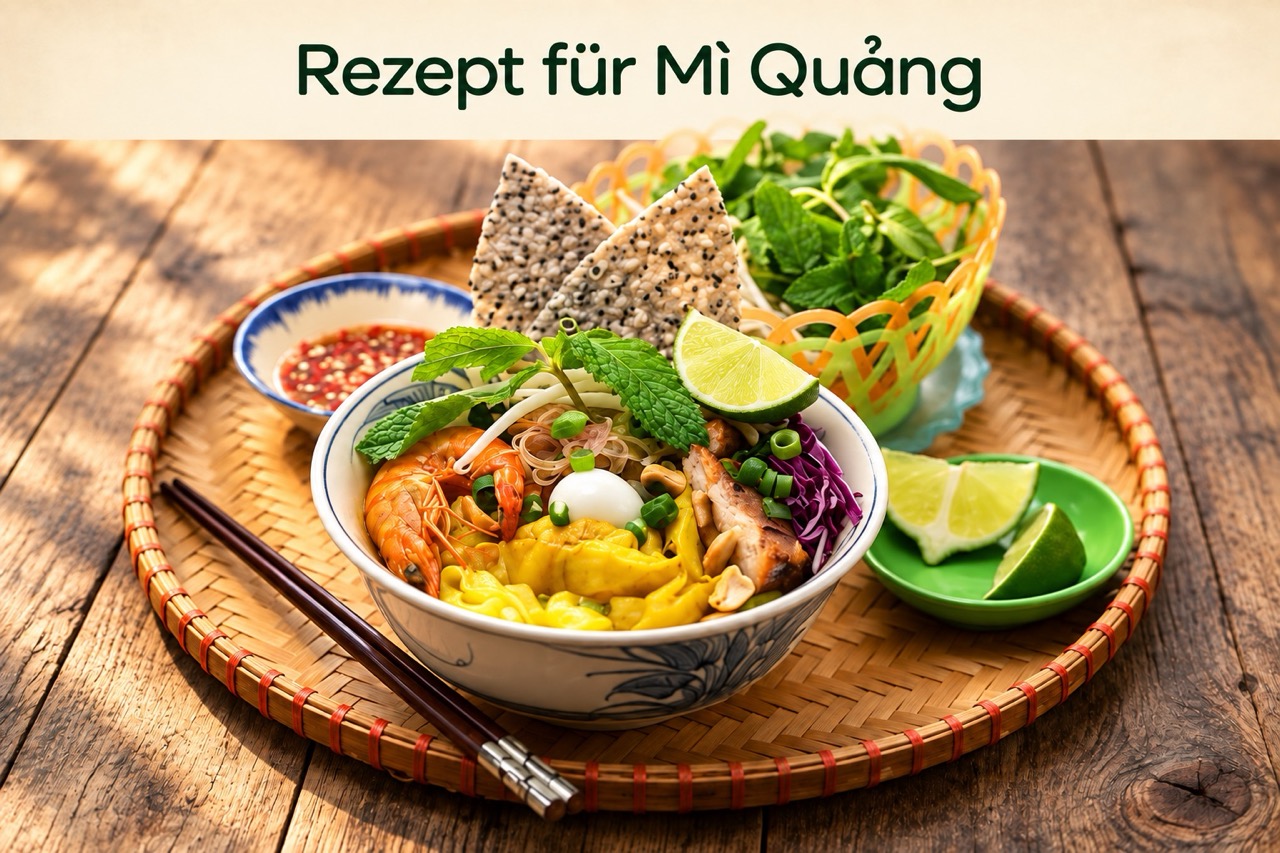
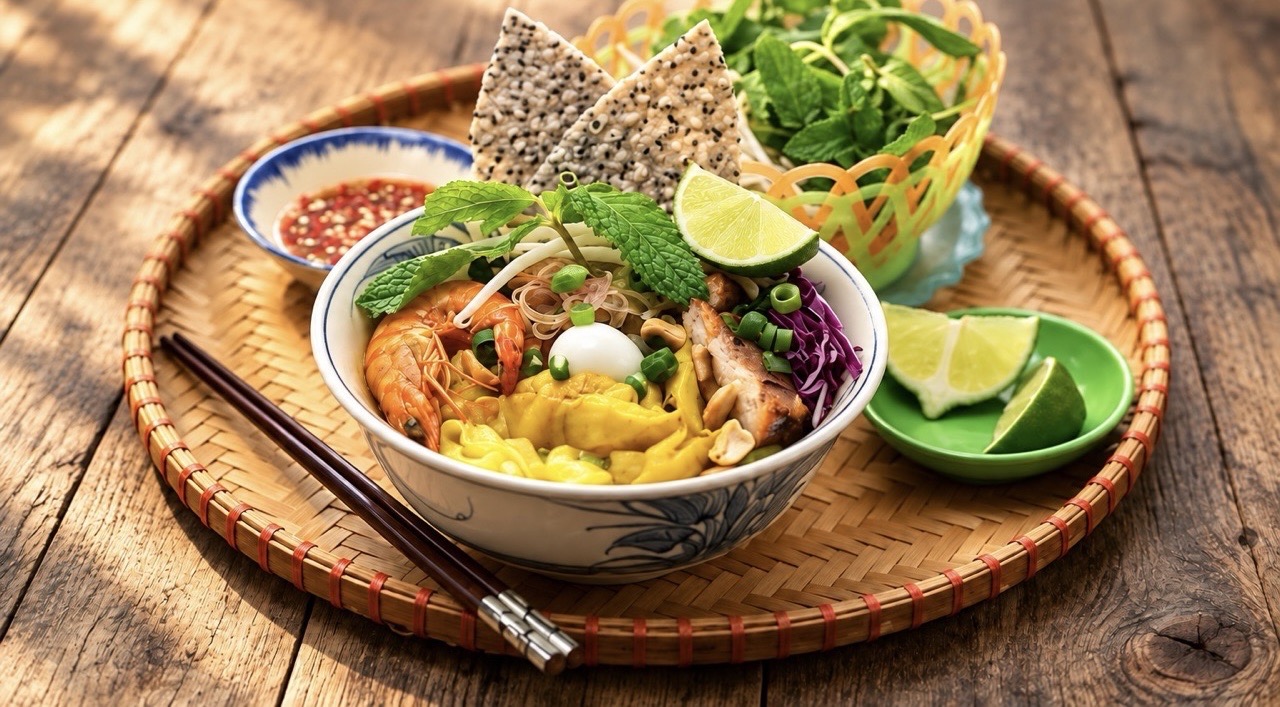
Discover the flavours of Central Vietnam with this Mì Quảng recipe. Wide rice noodles are topped with succulent shrimp, savoury pork belly and a small amount of richly seasoned broth. Roasted peanuts, fresh herbs and crispy rice crackers bring contrasting textures to every bite. Follow these steps to recreate this Vietnamese speciality at home.
1. Origins and Food Culture
Mì Quảng is one of the most iconic dishes from Quảng Nam in Central Vietnam. Unlike Phở and many other Vietnamese noodle soups, the noodles are not submerged in broth. Instead, a small amount of concentrated, flavourful broth is spooned over them.
Fresh herbs, leafy greens, roasted peanuts and crispy rice crackers are traditional accompaniments. Together, they give the dish its distinctive character and reflect the food culture of Central Vietnam.
2. Flavour
The dish combines the gentle sweetness of pork bone broth with a richly seasoned, slightly thickened shrimp and pork sauce.
The tender, chewy rice noodles complement the mild richness of quail eggs and the nutty flavour of roasted peanuts. Fried củ nén—small Vietnamese allium bulbs—and peanut oil add a distinctive aroma.
3. Difficulty
Difficulty: Intermediate
This recipe involves several stages: preparing the ingredients, marinating the pork and shrimp, simmering the broth and cooking the toppings separately. However, the cooking techniques are straightforward and manageable when followed in order.
4. Ingredients
- 400 g Mì Quảng noodles; alternatively, use wide rice noodles such as those used for Phở. Udon noodles can also be used, although their texture will be different.
- 500 g pork tail bones
- 500 g shrimp
- 500 g pork belly
- 20 quail eggs, boiled and peeled
- 1 chicken egg
- 200 ml peanut oil, preferably suitable for frying
- 2 tbsp annatto oil
- 100 g peanuts
- 15 củ nén bulbs
- 5 shallots
- 1 onion
- ½ white radish
- 3 spring onions
- 3 culantro leaves, also known as sawtooth coriander or ngò gai
- 1 piece of fresh turmeric
- 6 tbsp fish sauce
- 10 crispy Vietnamese rice crackers, bánh đa nướng
- Fresh lettuce, herbs and optional bean sprouts, to serve
- Sugar, salt, ground pepper and optional monosodium glutamate (MSG), for seasoning
Measurements: tbsp = tablespoon; tsp = teaspoon.
5. Instructions
Prepare the Pork Bone Broth
- Blanch the pork tail bones in boiling water for about 5 minutes. Drain and rinse thoroughly.
- Bring 3 litres of water to a boil in a large pot. Add the bones and simmer over medium heat for approximately 40 minutes. Skim off the foam regularly.
- Peel the onion and cut the white radish into large pieces. Add both to the pot and simmer for another 50 minutes.
- Add a further 1.5 litres of water, bring the broth back to a boil and turn off the heat.
Prepare the Seasonings, Peanuts and Herbs
- Using a mortar and pestle, finely crush 20 g of peanuts with the peeled turmeric.
- Dry-roast the remaining 80 g of peanuts, then remove their thin skins.
- Trim and wash the củ nén bulbs, then crush them in a mortar.
- Wash and finely chop the spring onions and culantro.
- Peel and finely chop the shallots. Wash the lettuce and other herbs, then drain well.
Prepare and Marinate the Pork Belly
- Bring a small pot of water to a boil with ½ tsp salt. Blanch the pork belly for about 2 minutes.
- Rinse the pork and cut it into thin slices approximately 3–4 cm long.
- Mix the pork with:
- 1 tsp salt
- 1 tsp MSG, optional
- 1 tsp ground pepper
- 1 tbsp fish sauce
- 2 tsp finely chopped shallots
- 1 tsp crushed củ nén
- 1 tsp sugar
- Cover and marinate in the refrigerator for about 30 minutes.
Prepare and Marinate the Shrimp
- Remove the shrimp heads and legs, then devein. Remove the shells too, if preferred.
- Briefly clean the shrimp in water mixed with 1 tsp salt, then drain thoroughly.
- Mix the shrimp with:
- 1 tsp salt
- 1 tsp MSG, optional
- 1 tsp finely chopped shallots
- 1 tsp crushed củ nén
- Cover and marinate in the refrigerator for about 30 minutes.
Warm the Peanut Oil and Fry the Củ Nén
- Gently warm the peanut oil, following the manufacturer’s guidance on suitable cooking temperatures. Do not heat it until it smokes.
- Pour approximately 100 ml of the oil into a frying pan. Add half of the remaining crushed củ nén and fry over medium heat until golden and fragrant.
- Remove the fried củ nén and set aside for garnishing. Keep the infused oil for cooking.
Cook the Shrimp and Pork
- Heat 1 tbsp of the infused oil in a frying pan.
- Stir-fry the shrimp over medium-high heat for approximately 3–5 minutes, depending on their size, until just cooked through. Transfer to a plate.
- Warm 3 tbsp peanut oil in the same pan.
- Add the remaining crushed củ nén and the crushed peanut–turmeric mixture. Fry briefly until fragrant.
- Add the marinated pork belly and stir-fry for about 4 minutes.
Make the Richly Seasoned Sauce
- Pour 1.5 litres of the prepared pork bone broth into the pan containing the pork.
- Add the boiled quail eggs, then gradually stir in:
- Up to 1 tbsp salt
- Up to 1 tbsp MSG, optional
- 1 tbsp sugar
- 4 tbsp fish sauce
- 2 tbsp annatto oil
- Bring to a boil, then simmer until the pork is fully cooked. Add the salt and fish sauce gradually, tasting as you go.
- Beat the chicken egg and slowly pour it into the gently simmering sauce while stirring.
- Return the cooked shrimp to the pan and warm through briefly. Allow the egg to set completely, adjust the seasoning and turn off the heat.
Season the Remaining Broth and Assemble
- Bring the remaining pork bone broth back to a boil.
- Season with 2 tsp salt, 1 tsp MSG if desired, 1 tsp sugar and 1 tbsp fish sauce. Adjust to taste. This broth should be more lightly seasoned than the shrimp and pork sauce.
- Prepare the Mì Quảng noodles according to the package instructions. Fresh, precooked noodles can be briefly warmed in hot water; dried noodles must first be fully cooked.
- Divide the noodles among serving bowls. Arrange the pork belly, shrimp and quail eggs on top.
- If desired, drizzle each bowl with ½ tsp peanut oil. Sprinkle with spring onions, culantro, fried củ nén and roasted peanuts.
- Spoon over a small amount of the richly seasoned sauce, leaving the noodles only partly surrounded by liquid.
- Serve with fresh herbs, lettuce and broken pieces of crispy rice crackers. Add a little of the milder broth if you prefer more liquid.
6. Where to Buy Ingredients in Germany
Speciality ingredients such as Mì Quảng noodles, củ nén and Vietnamese rice crackers may be difficult to find in regular German supermarkets. Asian and Vietnamese grocery stores are often a better place to look.
- Dong Xuan Center Leipzig: Maximilianallee 14–16, 04129 Leipzig. The centre offers various shopping options for Asian groceries.
- go asia supermarkets: Try the Petersstraße branch in Leipzig or other locations across Germany. Contact the store beforehand to check whether specific Vietnamese ingredients are available.
- Asian online grocery stores: Search for “Mì Quảng noodles”, “củ nén”, “bánh đa nướng” and “annatto oil”. Product ranges and availability vary between retailers.
Tip: If you cannot find củ nén, substitute a little garlic and shallot. The flavour will be different, but the combination still works well in this dish.
7. Frequently Asked Questions
Do I need to heat peanut oil until it smokes?
Some traditional recipes call for strongly flavoured peanut oil to be heated intensely before use. For home cooking, however, do not deliberately heat the oil until it smokes. Choose peanut oil suitable for frying and follow the instructions on the packaging. Frying the củ nén in the oil will add extra aroma.
Why is a chicken egg stirred into the sauce?
The beaten egg sets in the hot liquid, forming delicate strands and giving the sauce more body and a slightly thicker texture. Pour it in slowly while stirring.
Why are the rich sauce and the mild broth prepared separately?
In this version, the sauce is cooked with the pork and shrimp and seasoned more intensely. Only a small amount is spooned over the noodles.
The remaining pork bone broth is seasoned more lightly. This allows everyone to add extra broth according to their preference without making the dish overly salty or strongly seasoned.
Mit über einem Jahr Erfahrung im Content Writing und in der redaktionellen Bearbeitung erstelle ich klare und verständliche Inhalte über vietnamesische Spezialitäten, natürliche Trockenprodukte und passende Genussideen für internationale Kundinnen und Kunden. Bei VietNatur möchte ich hilfreiche Informationen bieten, damit Leserinnen und Leser Vietnams Aromen einfach entdecken können.